
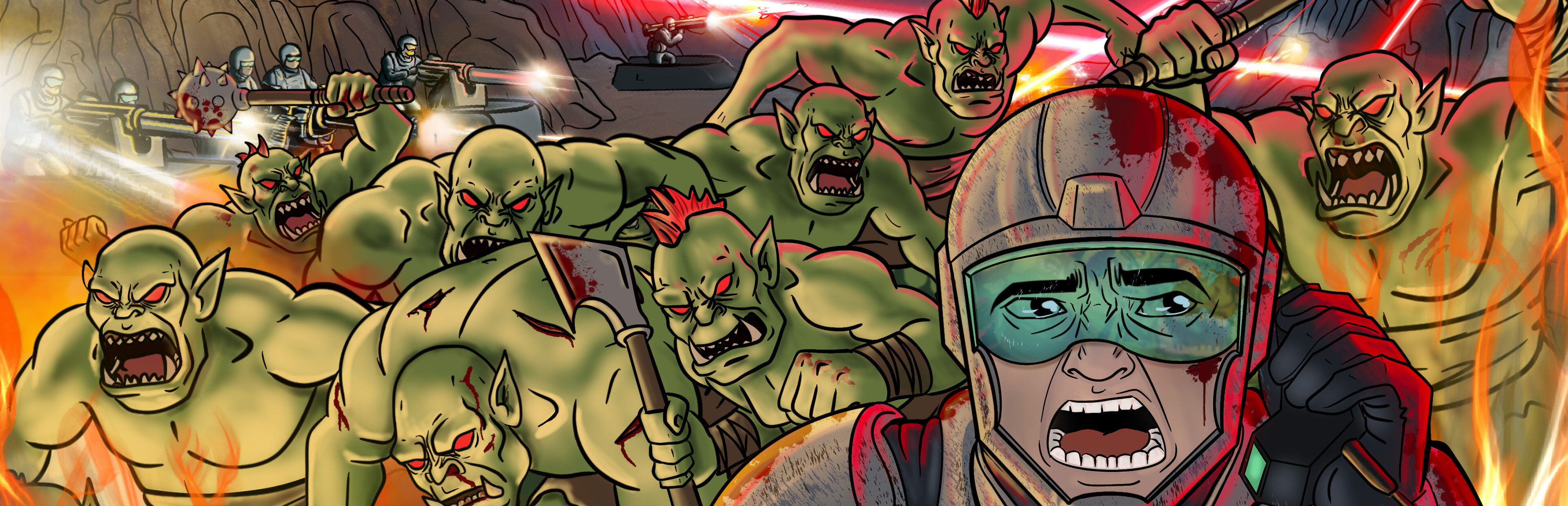
In brief: Mumpitz Games says two developers built the game in roughly four months, beginning from a Godot GPU-physics prototype and using Outhold as the main gameplay inspiration. The studio reported $361,657 in gross revenue during the first 24 hours; gross revenue is not profit.
Who made Sir, We Have an Orc Problem?
The Steam store names Mumpitz Games as both developer and publisher. In a launch retrospective posted under the KaTeKaPe account and signed “Laurin,” the studio says the project was made by a two-person team after its previous three-person lineup split following Tiny Auto Knights.
The same post adds the context that disappears from the viral headline: both developers had programmed for more than ten years and had spent more than half of that time working professionally in games. Before forming the studio, they worked on mobile ports of successful PC games, experience Laurin connects to performance optimization, bug fixing and shipping software.
“Four months” does not mean “first game”
The short production cycle describes this project's scope. It does not erase the years of technical experience, the previous commercial release or the custom rendering work behind the crowd simulation.
A Godot physics experiment found a simpler game
According to Laurin's retrospective, work began around March 2026 with a prototype for a GPU physics engine in Godot. The original idea involved 2D terrain destruction driven by physical bullets and bombs, but the team could not turn that prototype into a game it found fun.
The pivot was deliberately conservative: keep the unusual simulation, attach it to proven tower-defense and incremental mechanics, and raise the enemy count to ten thousand or even one hundred thousand. Laurin names Outhold as the main inspiration. That makes Outhold more than an editorial recommendation; it is the direct comparison identified by the developer.
How the game moves so many orcs
When asked about the technology in the Reddit thread, Laurin answered that the game uses custom GPU compute shaders. The official June demo notes separately mention moving explosion simulation and rendering to the GPU and continuing general performance work. Together, those sources support a narrow conclusion: custom GPU work is central to the spectacle. They do not expose enough implementation detail to publish a complete technical architecture.
The public development and launch timeline
| Date | Event | Source |
|---|---|---|
| March 2026 | Physics prototype work begins, then pivots toward incremental tower defense. | Developer retrospective. |
| April 9 | Steam page goes live; the developer reports 900 first-day wishlists. | Developer-reported metric. |
| April 30 | Open playtest launches; the developer reports 200 concurrent players on day one. | Developer retrospective plus contemporary public posts. |
| June 2 | The official Steam news feed announces the demo replacing the playtest. | Official dated Steam announcement. |
| June | The developer reports 36,000 Next Fest players, about 18,000 wishlists and the #41 most-played demo position. | Developer-reported snapshot. |
| July 28 | Full game releases on Steam. | Official store and launch announcement. |
| First 24 hours | The studio reports $361,657 gross revenue. | Developer-reported gross, later covered by GamesRadar. |
| August 1 | The studio announces 100,000 sales and says more details about future plans are coming. | Official dated Steam announcement. |
| August 4 | First post-launch patch (Update 2026.08.02.13.35) and the Supporter Pack DLC publish. | Official Steam announcements. |
One date conflicts in the public record
The retrospective says the demo released on May 2, while the official Steam news announcement is dated June 2. This timeline uses the official Steam timestamp and does not silently repeat the conflicting month as fact.
Why social posts mattered before the Steam page
The team posted short prototype clips before the store page existed. Laurin says some passed 100,000 views and created direct requests for a Steam page. After the page launched, the team continued posting daily work-in-progress clips. In a reply, Laurin says the same videos went to TikTok, Instagram and YouTube, with Instagram providing the most consistent reach for this project.
That is a report of what worked for one release, not proof that frequent low-edit posts guarantee wishlists for every game. The post itself acknowledges luck, and the team's professional experience makes a simple “copy this four-month formula” conclusion misleading.
Revenue, sales rank and review figures need timestamps
The launch post reports $361,657 in gross revenue during the first 24 hours, a peak of 7,684 concurrent players five hours after release, and the game sitting at #18 on Steam's top-seller list when the post was written. GamesRadar independently covered the story and reported the same revenue claim in rounded form.
| Claim | Safe wording | What it does not mean |
|---|---|---|
| $361,657 | Developer-reported first-24-hour gross revenue. | Not profit, take-home pay or a durable current total. |
| 7,684 concurrent | Developer-reported launch-day peak at that point in time. | Not lifetime players or units sold. |
| #18 top seller | A moving Steam chart position when the post was written. | Not a permanent rank. |
| Four months | Approximate project development cycle stated by the studio. | Not the team's total experience or a beginner benchmark. |
| 100,000 sales | Official milestone announced by the studio on August 1, 2026. | Not a revenue figure; the announcement does not attach one. |
The first-week follow-up coverage
One week after launch, GamesRadar reported the studio's own figure of $1,053,927 in gross revenue — with $898,460 net of taxes, refunds and chargebacks — and noted the game had crossed the threshold Steam community sleuths associate with Valve's "chocolate tier," the roughly $800,000 annual-revenue mark that reportedly earns developers a box of chocolate. Those are press-reported and developer-sourced numbers, not audited accounts, and the chocolate-tier threshold is community understanding, not an official Valve rule. The same week, GamingOnLinux published a positive review calling the game "a satisfying incremental-style tower defense with enemies flowing like waves."
What can reasonably be inferred
The pattern is tighter than the viral moral. Mumpitz Games found a visually legible hook, showed it early, watched for genuine audience response, and kept the final scope compact. That sequence does not prove that small games always outperform large ones, that social algorithms are predictable, or that every four-month project can reproduce this launch.