
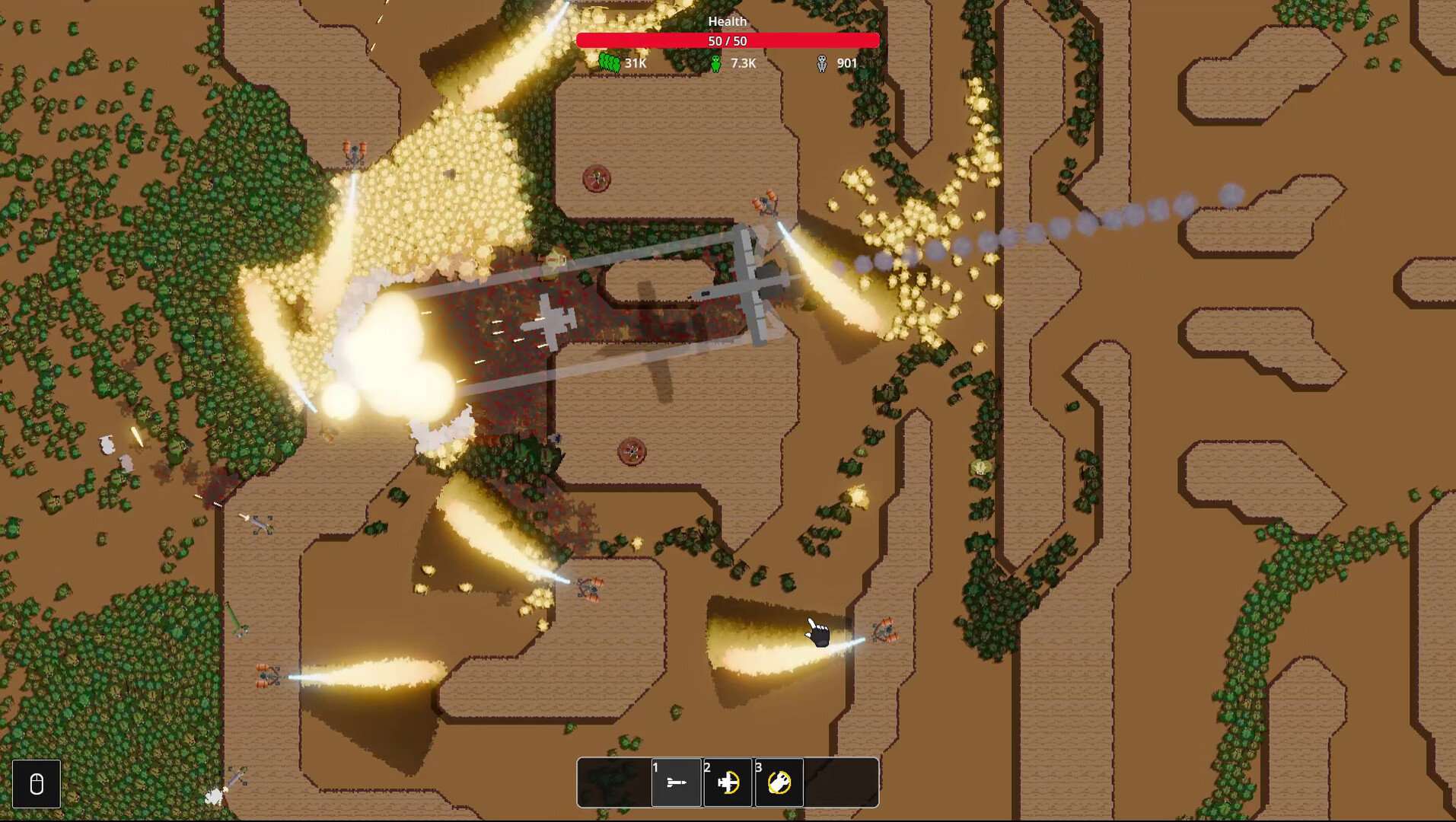
Closest direct influence: start with Outhold. Mumpitz Games names it as the project's main gameplay inspiration. Choose Creeper World 4 instead if the liquid-like enemy mass is the part you cannot stop thinking about.
Pick by the feature you want
| Game | Best match | Main difference |
|---|---|---|
| Outhold ↗ | Persistent upgrades and repeat runs | It is smaller-scale and more abstract, without the same physics-heavy orc flood. |
| Creeper World 4 ↗ | A fluid enemy front | It is a broader real-time strategy game, not a compact tower-defense campaign. |
| Dungeon Warfare ↗ | Physics traps and kill boxes | You defend a dungeon with traps rather than direct firearm towers against one huge simulated crowd. |
| Rogue Tower ↗ | Replayable tower builds | Random runs and path expansion matter more than permanent incremental escalation. |
| Thronefall ↗ | Compact active defense | It adds character combat and kingdom economy, without the liquid-like crowd simulation. |
Outhold: the developer-named inspiration
Outhold is the strongest comparison because it is not based only on visual resemblance. In Mumpitz Games' launch retrospective, Laurin identifies Outhold as the main gameplay inspiration behind the pivot from a physics prototype to an incremental tower-defense game. Its own Steam page supports the mechanical overlap: repeated runs, permanent progression, a deep upgrade tree and tower synergies.
The difference is just as important. Outhold presents a more abstract, smaller-scale defense. Pick it for the progression structure, not for tens of thousands of individually simulated orcs.
Four alternatives for four different strengths
Creeper World 4: A fluid enemy front
The enemy spreads like a liquid across 3D terrain, turning containment, pressure and reclaimed ground into the battle line.
Best for: The moving mass of enemies is the feature you want more than the upgrade grind.
Know the difference: It is a broader real-time strategy game, not a compact tower-defense campaign.
Why it matches: Its official store description identifies the Creeper as a fluid enemy that floods terrain.
Dungeon Warfare: Physics traps and kill boxes
Push, crush and reroute attackers through handcrafted defenses, then spend permanent upgrade points on stronger traps.
Best for: You enjoy choke-point engineering and the physical consequences of each placement.
Know the difference: You defend a dungeon with traps rather than direct firearm towers against one huge simulated crowd.
Why it matches: The official page explicitly presents physics-based traps, handcrafted levels and permanent upgrades.
Rogue Tower: Replayable tower builds
An expanding path, card-drawn upgrades and procedurally assembled runs force the defense to adapt instead of following one fixed layout.
Best for: You want more build variance and a stronger roguelike structure.
Know the difference: Random runs and path expansion matter more than permanent incremental escalation.
Why it matches: Its official page describes an expanding path, roguelike elements and towers that gain experience.
Thronefall: Compact active defense
Build during the day, defend at night, choose weapons and perks, and fight alongside the defenses in streamlined sessions.
Best for: You want short strategic battles with direct player control.
Know the difference: It adds character combat and kingdom economy, without the liquid-like crowd simulation.
Why it matches: The official page centers daytime construction, nighttime defense and hands-on combat.
Choose the feature you want to keep
Reddit threads about Sir, We Have an Orc Problem repeatedly ask for three things: another physics-heavy horde, another compact game with permanent upgrades, or a tower defense that rewards elaborate kill boxes. Those requests determined the comparison categories. Outhold covers persistent progression, Creeper World 4 the flowing enemy front, Dungeon Warfare the physics kill box, Rogue Tower changing builds and Thronefall compact active defense.
The list does not copy current prices, discounts, review scores or player counts, because all four can change. It also avoids numerical similarity scores: no honest measurement can turn five different design priorities into one permanent ranking.
A useful recommendation starts with the mismatch
Creeper World 4 matches the flowing enemy front but changes genre; Dungeon Warfare matches physical kill boxes but changes the fantasy; Rogue Tower changes the run structure; Thronefall adds direct combat. The comparison is strongest when those limits remain visible.